Monday, August 10, 2009

Abstract


Phosphor thermometry is an increasingly popular method of making surface temperature measurements. The primary benefits of phosphor thermometry are that it does not require equipment to make contact with the surface and can be done remotely. This method uses a phosphor that exhibits one or more of the following changes with variations in temperature: change in decay time, change in relative intensities of emission peaks, or shifts in emission peak wavelengths. These changes with temperature are tested in a controlled setting to calibrate the phosphor for use.

Pyrochlores are a class of materials that follow the chemical structure A23+B24+O7 in which A and B can be a wide range of cations though they are generally rare earth elements or transition metals. Pyrochlores generally have low thermal conductivity allowing for their use in insulation materials for machinery such as turbines. When doped with rare earth elements such as europium, pyrochlores can act as thermographic phosphors making them useful for phosphor thermometry.

Previous research in this field has typically dealt with the thermal and material properties of these pyrochlores including: thermal conductivity, thermal expansion coefficient, fixed temperature spectroscopic properties. The purpose of this research project was to examine the temperature-dependent spectroscopic properties of three particular europium-doped pyrochlores in order to determine their suitability as thermographic phosphors. The pyrochlores tested included: La2Zr2O7:Eu, La2Hf2O7:Eu, and Nd2Zr2O7:Eu. The pyrochlores were synthesized using combustion synthesis at Vanderbilt University. The temperature-dependent spectroscopy was then done at Oak Ridge National Laboratory which had the necessary equipment. The change in emission decay times for these phosphors with changing temperature was measured. The ultimate goal was to determine the luminescent lifetime as a function of temperature for these materials.

Wednesday, August 5, 2009

Synthesis of Pyrochlores


The first step in the experimentation process was the synthesis of the pyrochlores used for testing. This involved creating an aqueous solution of the necessary reagents using the following stoichiometric equation:

18HfO(NO3)2+18La(NO3)3+50C2H5NO2->9La2Hf2O7+100CO2+125H2O+70N2

A calculated amount of La(NO3)3 was replaced with Eu(NO3)3 to dope the samples at a 4 mol % level. The equation above was used to synthesize La2Hf2O7:Eu. The reagents were altered as appropriate but following the same general formula in order to synthesize the other pyrochlores. The appropriate amounts of each chemical were measured on the electronic mass scale shown in the first picture. These chemicals were then poured into a crucible shown in the second and third pictures and dissolved in 15 ml of water.

The next step was to heat the hot plate shown in the second picture to 540 degrees Celsius and put the crucible containing the aqueous solution on top. Within 10 minutes the combustion took place as seen in the second picture. A large flame erupted from the crucible and died down in just a few seconds. A large puffy mass also formed at this time as shown in the third picture. This mass was the pyrochlore that was formed. It was ground into a powder in a mortar and pestle and stored in a vial for later analysis and testing.

Tuesday, August 4, 2009

Annealing of Pyroclores and XRD Characterization


The next step was to anneal the pyrochlores. Combustion synthesis is a relatively simple method of creating the pyrochlores however during the combustion, carbon impurities enter the sample showing up as black and grey specks in the powder sample. This "dirty" look to the powders immediately after combustion synthesis is shown in the first picture. In addition, the process leaves the crystalline structure of the powders heterogeneous and sometimes incompletely formed. The process of annealing in which the powders are heated in crucibles at 1200 degrees Celsius for 2 hours removes the impurities in the pyrochlores and improves their crystallinity.

Half the mass of each pyrochlore was placed in a crucible and set in the furnace shown in the second picture. The furnace was set to 1200 degrees Celsius and allowed to run for 2 hours. The powders were then allowed to cool outside the furnace and stored in separate vials. The appearance of the powders after the annealing process can be seen in the third picture. The carbon impurities evaporate away at such high temperatures making the powders appear much cleaner and uniform in color.

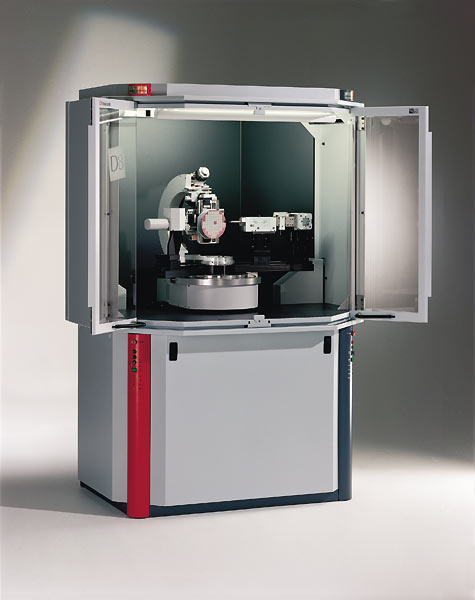
The powders were then characterized using an XRD or X-Ray Diffractor which is shown in the fourth picture. The XRD hits a small sample of a powder with an X-ray and measures the scattered intensity of the X-ray. The intensity measured is plotted against the respective angle of measurement for that intensity. This creates a graph that can be compared to standardized graphs maintained by the International Center for Diffraction Data (ICDD) to make sure the powder formed is what was expected. The confirmed diffraction pattern from the ICDD for a certain chemical (i.e. La2Zr2O7 in one case) is laid over the diffraction pattern being created from the powder sample in the XRD. If the relative intensities and locations of peaks match up properly, it is confirmed that the sample synthesized is what it was expected to be. The XRD characterization showed that all of the pyrochlores had been properly synthesized and were ready for spectroscopic characterization at Oak Ridge National Laboratory.

Monday, August 3, 2009

Data Collection

The testing was conducted at Oak Ridge National Laboratory so we weren't able to take pictures of the data collection and experimentation process. The process was relatively simple, however, with the equipment at Oak Ridge. Samples of each pyrochlore were placed on different Pyrex curved glasses. One sample was placed in a furnace which was modified to have include a small hole at the top to allow a laser to shine on the sample in the furnace. We used a nitrogen laser operating at 337 nm to excite the phosphor in the furnace. A fiber-optic cable was used to carry the laser and position it properly and another directly next to it was used to carry the emissions from the phosphor away from the furnace. These light emissions from the pyrochlore were carried to a photomultiplier tube which work to detect the intensity of light over a certain period of time. The lifetime, or decay time, of the emissions from the pyrochlores was calculated by taking many measurements of the intensity of the emissions versus time at various temperatures. Finding the decay time for each pyrochlore at each temperature was the primary focus of this research. By calibrating the decay times for each temperature (i.e. this decay time corresponds to this temperature), the pyrochlores could be used as thermographic phosphors.

The graphs above are the decay time versus temperature for two of the pyrochlores that were tested. As seen, the decay time initially starts out relatively flat. In this flat range, the pyrochlores can't be used as thermographic phosphors because a specific decay time can't be assigned to a temperature. As the decay time starts to slope downward with temperature, the pyrochlores become usable as thermographic phosphor. For the compound in the first graph, lanthanum zirconate, this downward trends stops at approximately 800 degrees Celsius. At this point, the graph starts to flatten out again because the intensity of the emissions at this temperature are so low that change in decay time can not be calculated and roughly stays constant. This means that the pyrochlore can not be used as a thermographic phosphor at temperatures above that cutoff temperature where the graph starts to flatten out again. Optimally, we would have found a pyrochlore that sloped downward on this type of graph into temperatures well over 1200 degrees Celsius. The graphs show that lanthanum zirconate can be used to measure temperatures at higher temperatures than lanthanum hafnate which begins to show no change in decay time at approximately 600 degrees Celsius.

Sunday, August 2, 2009

General Reflections

1. Of the myriad of options available, why did this particular experience appeal to you?

I began a precursor to this research during the Spring 2009 semester. I signed up for the research during the semester to satisfy a Mechanical Engineering elective requirement. After working on the research, I came to greatly enjoy the freedom and responsibility involved in the research process. It was my job to search through the vast amounts of scientific literature for any information relevant to our project and conduct the experimentation. I worked with multiple people to learn about the equipment I would be using and how best to set it up. Most importantly, it was my job to make any decisions regarding problems or questions with the research. For example I chose dopant percentages for the phosphors I created, synthesized them myself after getting the necessary supplies, designed much of the optics setup used for testing, and analyzed and compiled the data for presentation. Ultimately I had to report results to the professors involved, but I had plenty of freedom in how to conduct the research. After my research this past semester I felt I could extend the project I was doing into the summer by working with additional types of phosphors. This idea really appealed to me since I already gained a lot of experience and knowledge about the field with my research during the summer.


2. What do you know about yourself now that you didn't know prior to this experience?

I learned that I enjoyed the vast responsibility and freedom that came with an independent research project. I had professors and graduate students guiding me but much of the specific details involved were new to them as well. I liked that the success of the research was primarily a product of my effort, responsibility, and initiative. I had a large assortment of resources to pore through for each part of the research. I was able to exhaust these resources to determine how to synthesize the pyrochlores, perform the synthesis, conduct the various types of testing (XRD, spectroscopy, etc.), interpret the data, and present the results in a meaningful fashion. Seeing the success of my research and the data I was presented with enforced my appreciation for the freedom and responsiblity I was given when I took on this project.


3. What impact will this experience have on the short-term (class selection, major, minor) and long-term choices you will make regarding your education?

This experience was a result of my major in Mechanical Engineering and will not have much impact on my short-term choices involving my education. I will be doing independent study with the same faculty advisers this coming semester in order to follow up on my research. I will focus my time on completing and extending the interpretation of the data and writing a paper detailing the findings. I will present the findings at a conference held by the American Institute of Aeronautics and Astronautics in Orlando. Prior to this research experience I became very interested in law and have decided to apply to law school. This experience has only furthered my interest in law. Although ostensibly different, the field of law and scientific research have many similarities that I appreciate. In scientific research, one must consult numerous resources such as scientific literature and correspondence with experts in the field to design a worthy experiment. Similarly, in the field of law one must pore through the stories of witnesses and experts and recognize precedents to construct a case. Both fundamentally require one to exhaust all available resources to create an experiment or case with as few holes as possible.


4. How have your career/graduate study plans been affected by this experience?

As mentioned above, this experience has only increased my interest in the field of law. I had already decided to pursue a legal career based on previous experiences and interactions with people. I feel like this experience has helped me gain and improve many skills that will benefit me in a legal profession. For example, the ability to extract the important information from dense, highly technical scientific literature. In addition, this experience has generally improved my initiative, my ability to think of innovative solutions to problems, and my methods of searching for useful information.

Research Experience Questions

1. What are the key questions being addressed by the research and why are they important?

The purpose of this research was to determine the effectiveness of certain compounds, pyrochlores in this case, as thermographic phosphors. These pyrochlores are already known as compounds that can withstand high temperatures (~1300 degrees Celsius) which gives them a wide range of applications in thermal barrier coatings. The research was conducted to see if the pyrochlores could act as thermographic phosphors at such high temperatures so that the material used as insulation on a machine part could also be used to make temperature measurements. Finding a material that could physically withstand such high temperatures and be used as a thermographic phosphor at those temperatures would be a very important find. It would allow much more convenience in the insulation of machine parts, particularly parts in gas turbines, and lower costs as well. Gas turbines are able to run more efficiently the higher the operating temperature is. A material that can insulate against higher operating temperatures while also providing a way of very accurately monitoring those temperatures is very desirable. The primary goal of this research was to see if any of the pyrochlores that were tested would be able to satisfy both of these goals.


2. What did you learn about the potential applications of this research?

After the testing, I found that unfortunately the tested pyrochlores would not be usable at temperatures needed to improve average gas turbine efficiency. However, the pyrochlores still have some application as thermal barrier coatings for manufacturing processes and machinery that only go up to about 700 degrees Celsius. Although this doesn't provide a new utility to the industry (other compounds can currently be used for the same function), it does increase the amount of options available for that use and potentially lowers costs and increases customizability. For example, different excitation sources and receptors can be used for different types of thermographic phosphors. Another benefit of this research is simply that it tested a few pyrochlores and found that they weren't suitable. As mentioned in the abstract, pyrochlores are a very broad field of compounds. Many experts feel that pyrochlores are a group worth looking into for the purpose of finding a material that can provide excellent insulation and temperature measurements at very high temperatures. However, the group is extremely large and grows in size when considering dopants and dopant percentages which can vastly affect the material characteristics. Thus, testing different pyrochlores is the only way to see if a material with the desired properties can be found. The pyrochlores we tested had not been tested before with the same dopant at the same dopant percentage. Thus, we were able to narrow, albeit slightly, the field of pyrochlores to be tested in the future.


3. Discuss the potential impact - positive or negative - of the work your performed on a particular population (i.e.: women, Hispanics, economically disadvantaged, immigrants, etc.).

This research cannot easily be characterized as benefitting some specific group of people. The closest fit would be that this research and the field helps the economically disadvantaged. As mentioned above, finding a material that can insulate and provide temperature measurements at very high temperatures (above 1300 degrees Celsius) would be an important discovery. This is because it would make it more efficient and easier to operate gas turbines by allowing for higher temperatures and a convenient method of measuring those temperatures. Gas turbines are commonly used in electrical generators to provide electrical power. If gas turbines can operate more efficiently, electrical generators can as well. This lowers the operating costs of power companies. In many cases, the savings can be passed on to consumers as the power companies lower costs to attract more customers. This potential lower cost of energy is the most tangible benefit of research in this field. For the economically disadvantaged, being able to save additional money in any way possible is a great benefit. The economically disadvantaged have scarce financial resources and benefit the most from any decrease in the cost of living associated with energy costs.